Seafood exports in August recovered strongly
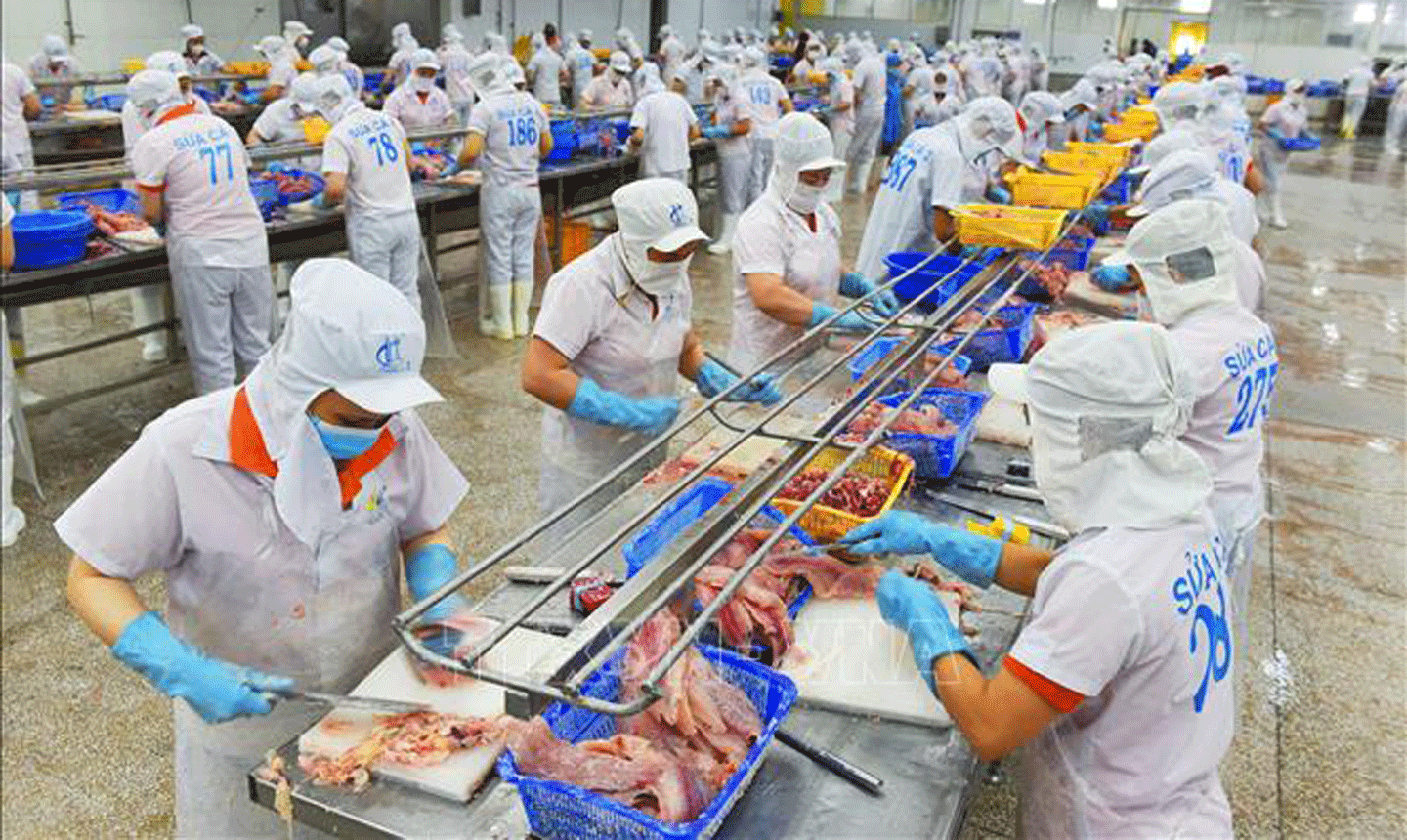
Seafood export turnover increased sharply in the context of positive demand from major markets. VASEP believes that seafood exports by the end of 2024 will fluctuate at 9.4-9.5 billion USD, an increase of nearly 6% compared to 2023.
According to the Association of Seafood Exporters and Producers, in August, seafood exports continued to recover with a growth rate of 20% reaching nearly 953 million USD. In the first 8 months of the year, seafood exports reached nearly 6.3 billion USD, up nearly 9% over the same period last year.
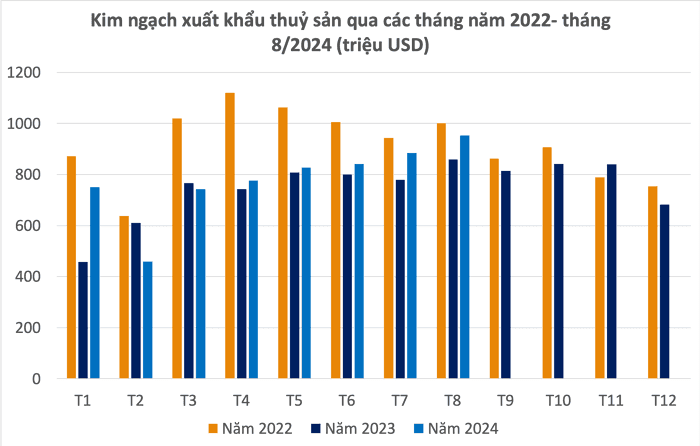
Source: General Department of Customs, VASEP (H.My compiled)
Except for squid and octopus, which saw a 15% decrease in export turnover in August, all other key products saw double- and triple-digit growth. Of which, shrimp exports increased by 30%, pangasius increased by 18%, tuna increased by 13% and other marine fish increased by 12%.
Shrimp exports by the end of August reached nearly 2.4 billion USD, up 9% over the same period last year, of which white-leg shrimp reached about 1.75 billion USD, up 8%, while black tiger shrimp exports were still 7% lower than the same period, reaching nearly 290 million USD.
Lobster alone maintained good growth momentum in August, so the export turnover in the first 8 months of the year was 140% higher than the same period in 2023.
VASEP said that in addition to the challenges of anti-subsidy and anti-dumping taxes, shrimp exports are showing a positive trend, with stable growth in recent months.
In addition, the association believes that the forecast of a decrease in global shrimp output in 2024 will also impact shrimp prices. Output from China, Ecuador and India is expected to decrease this year, causing global output to decrease by about 260,000 tons (equivalent to a decrease of 5%) to 4.9 million tons.
Shrimp consumption has begun to increase in Europe, and the US market has also recovered slightly. Although shrimp import prices into China are still low, these are also positive signs for the shrimp market.
Pangasius exports in the first eight months of the year reached nearly $1.3 billion, up 9% year-on-year. While exports to China remained stagnant, the recovery of the US market was a catalyst for growth in pangasius exports. Exports to the US increased 23% year-on-year, while exports to China still decreased by 3%.
The US continues to have demand for whitefish species under the bidding programs of the US Department of Agriculture.
On August 29, the US Department of Agriculture (USDA) announced that it would buy more seafood, this time Pacific cod, also known as cod, grouper fillets and catfish products. The department also announced that it paid $6.5 million for 1.5 million pounds of catfish. The purchase was divided among five processors in the US Gulf of Mexico region.
Tuna exports as of the end of August reached 652 million USD, up 21% over the same period in 2023. The general market trend is still in demand for tuna products from Vietnam, but in the coming months, tuna exports will find it difficult to maintain the good growth momentum as from the beginning of the year due to a lack of raw materials.
VASEP said that since Decree 37 took effect, with the minimum size regulation for skipjack tuna being 0.5m, businesses have been almost unable to buy tuna according to that size regulation, so there are not enough domestic raw materials to produce canned tuna, as well as other export products.
The export of squid and octopus was most clearly affected by the IUU yellow card. The issue of certifying and certifying the exploitation of this product encountered many difficulties, causing businesses to not have raw materials to ensure sufficient export documents. Therefore, by the end of August, squid and octopus exports still decreased by 2% compared to the same period, reaching 402 million USD.
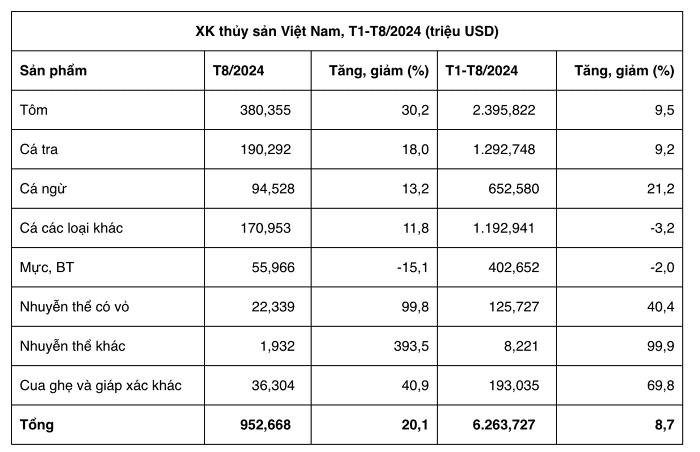
Source: VASEP
VASEP believes that in general, seafood exports to all markets are showing a more positive trend in terms of demand as well as a gradual recovery in prices.
However, there are still some major challenges that will limit growth in the coming months such as the IUU yellow card, anti-subsidy tax, anti-dumping tax, etc. Therefore, VASEP believes that seafood exports by the end of 2024 will fluctuate at 9.4-9.5 billion USD, an increase of nearly 6% compared to 2023.
Source: Vietnambiz