Canned tuna exports to EU face challenges

In 2024, Vietnam's canned tuna exports to the EU, after growing well in the first 5 months of the year, have continuously decreased in the last months of the year. In the fourth quarter of 2024 alone, canned tuna exports were at the same level as in the same period in 2023, reaching nearly 17 million USD. For the whole year of 2024, the export turnover of canned tuna to the EU reached nearly 74 million USD, an increase of 4% compared to 2023.
Germany leads in canned tuna imports
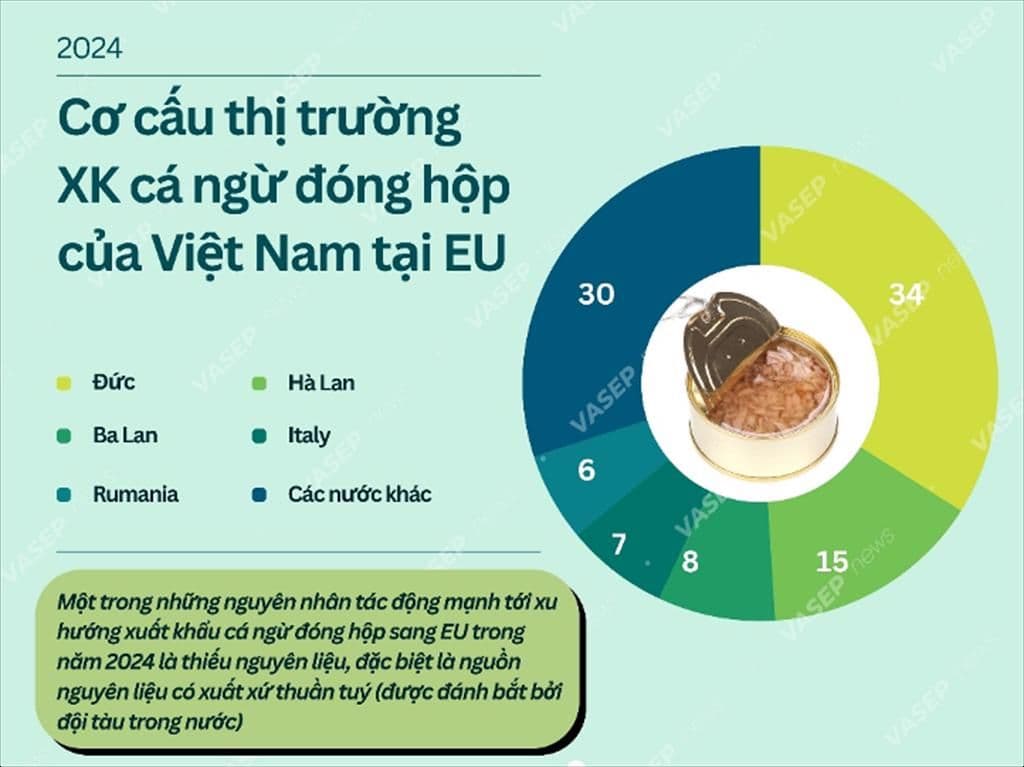
Currently, Germany, the Netherlands, Poland, Italy and Romania are the five largest import markets for canned tuna from Vietnam in 2024, accounting for 70% of the total export value.
In recent years, Germany has always been the leading export market for canned tuna from Vietnam in this market block. This is also a market that always has regular export orders every month. However, in recent years, the growth rate of canned tuna exports to this market has slowed down due to the impact of the Covid-19 pandemic, the economic crisis, etc.
On the contrary, exports to Poland have tended to grow strongly, although export orders to this market have not been regular. In 2024 alone, the export value of canned tuna to Poland increased by 48%, reaching more than 6 million USD.
Meanwhile, canned tuna exports to the Netherlands and Italy have tended to decrease. In 2024, exports to these two markets decreased by 2% and 13% respectively. Export orders to the Netherlands and Italy were also uneven last year.
Canned tuna exports to the EU face many difficulties
According to businesses, one of the reasons that strongly affects the trend of exporting canned tuna to the EU in 2024 is the lack of raw materials, especially raw materials of pure origin (caught by domestic fleets).
Since Decree No. 37/2024/ND-CP took effect on May 19, 2024, with regulations on the minimum size allowed for exploitation (management measures) that are not suitable for seafood species, including skipjack tuna, it has seriously affected the normal production and business activities of fishermen and businesses, increasing the economic burden on the related production chain.
Many batches of raw materials exploited by fishermen in provinces related to the above "regulations" in the past time are in a "suspended" and "stuck" state, in warehouses and cannot be exported when fishing ports and branches cannot issue S/C, C/C documents. Many orders, especially canned tuna, exported to markets that businesses have had to "miss", some signed contracts are being requested by customers to stop or fine the contract. Fishermen exploiting the above species face many difficulties when "buyers" do not "dare" to buy, are stagnant, some cannot go to sea as often as planned.
Export orders that must use imported raw materials are not entitled to tariff incentives according to the agreement in the Free Trade Agreement between Vietnam and the EU (abbreviated as EVFTA). This is reducing the competitiveness of Vietnamese canned tuna products in the EU market.
In addition, the list of aquatic species allowed to be traded in Vietnam in Appendix IV of Decree 37/2024/ND-CP is not clear, leading to unnecessary misunderstandings in the implementation of some responsible agencies/organizations, affecting the production and business activities of businesses.
Currently, the step By 2025, although the preferential tariff quota for canned tuna products from Vietnam to the EU has been restarted, Vietnam's export orders are still being held back due to the above issues. Therefore, the community of canned tuna exporting enterprises is looking forward to the Government soon issuing a Decree amending and supplementing a number of Decrees in the field of fisheries to facilitate and promote exports to the EU market.
Source: VASEP