Impact of ionizing radiation during irradiation of fruits, vegetables and foods
Food Irradiation (application of Ionizing radiation for food treatment) is a technology that can enhance the safety and extend the shelf life of various foods by reducing, eliminating, or deactivating microorganisms and insects present in the products.
In the United States, the Food and Drug Administration (FDA) is responsible for regulating radiation sources used for food irradiation. The FDA only approves radiation sources for use on food after determining that food irradiation with those sources is safe.
The FDA, along with other organizations such as the World Health Organization (WHO), the Food and Agriculture Organization of the United Nations (FAO), and the International Atomic Energy Agency (IAEA), has recognized Gamma rays, Electron beams, and X-rays as safe irradiation methods. However, adherence to irradiation dose regulations for each product and ensuring the procedures during irradiation are required.
Gamma Irradiation (Cobalt-60)
According to Saeedeh Zarbakhsh, Ph.D. at Shiraz University and Somayeh Rastegar, Associate Professor at Hormozgan University (2019), gamma irradiation (using Cobalt-60) is a safe way to treat food because it has a high penetration ability and can kill harmful microorganisms even through thick materials. Furthermore, a large body of research has shown that gamma irradiation can effectively reduce pests, insects, and microbiological load in a variety of fruits and vegetables without compromising their nutritional value or sensory qualities.
Additionally, studies have shown that irradiation can inhibit sprouting (e.g., potatoes, garlic) and delay the ripening process of fruits to extend their shelf life. For instance, a 2007 study by Zaman et al. reported that Gamma irradiation treatment on bananas extended their shelf life by 20 days and delayed the ripening process. Vanamala et al. (2007) also found that gamma irradiation was good for grapefruit. They found that low-dose irradiation could keep or increase the flavonoid content in the fruit pulp without hurting its quality.
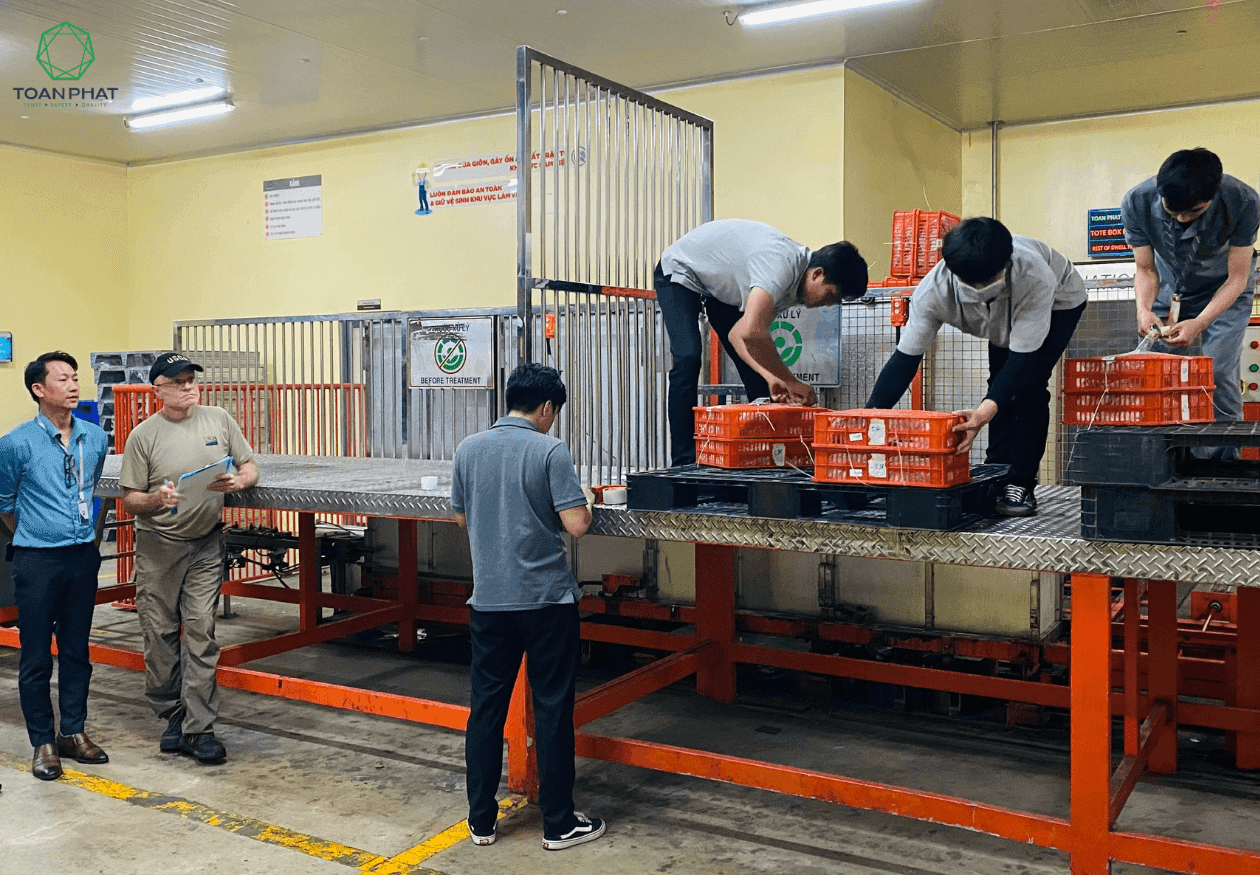
Toan Phat Irradiation processes fresh fruits using Cobalt-60 Gamma Irradiation
Electron Beam Irradiation (E-Beam)
Electron Beam (E-Beam) irradiation uses a stream of high-energy electrons from an electron accelerator to treat food.
E-Beam irradiation equipment does not rely on radioactive sources; instead, it uses high-charge electron streams generated by specialized devices such as linear electron accelerators. The food does not come into contact with radioactive substances, and irradiation maintains food quality while enhancing safety without leaving residual radioactivity.
E-Beam irradiation equipment features dual-sided beams, making the irradiation process three times faster than using Gamma irradiation equipment because all areas of the product can be irradiated in one cycle. However, E-Beam irradiation equipment has size limitations, so for larger and heavier products, Gamma irradiation equipment must be used.
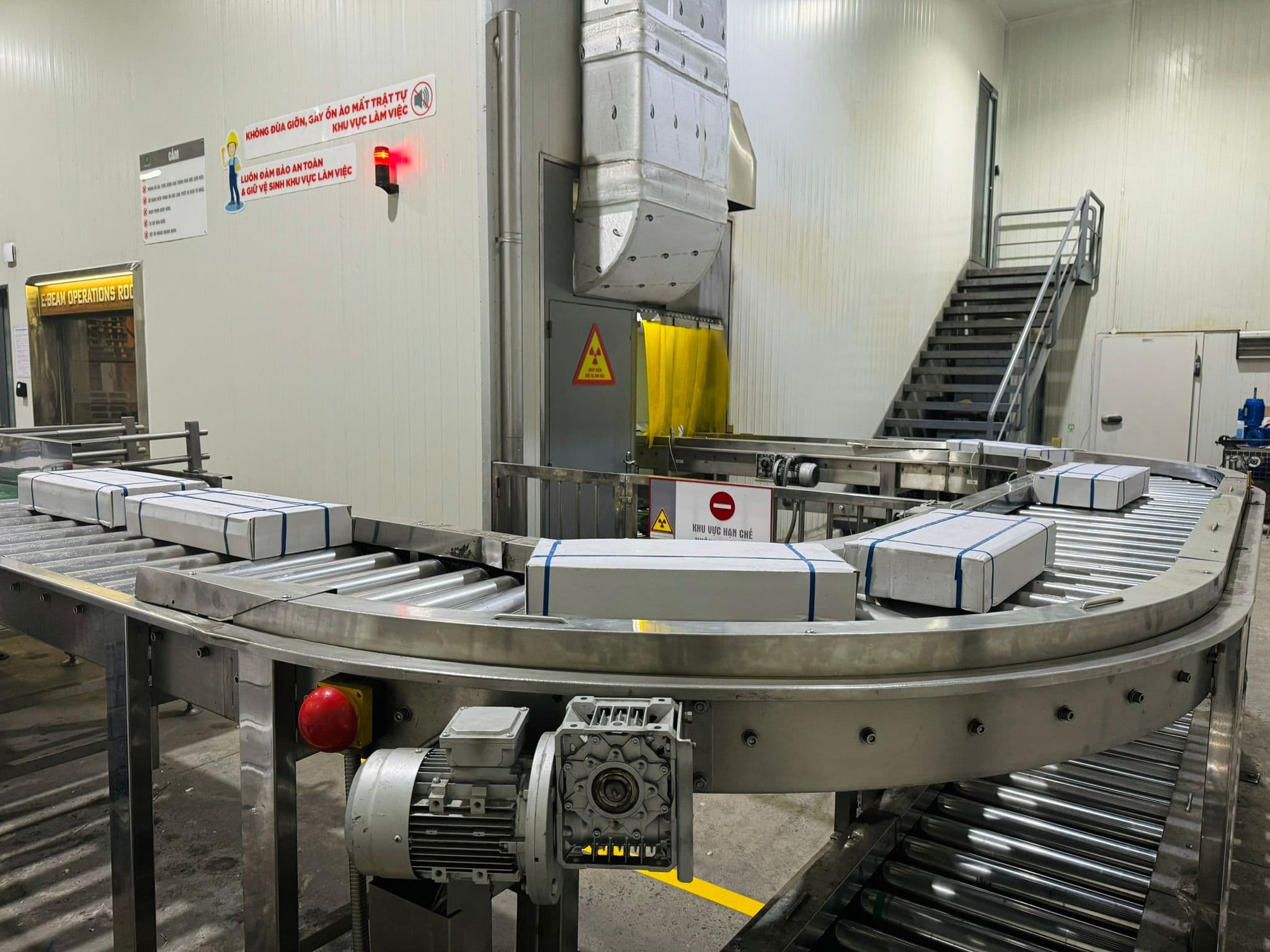
The Electron Beam (E-Beam) Irradiation Processing System at Toan Phat Irradiation
X-Ray Irradiation (Bremsstrahlung)
X-rays can be used as a more efficient method for food preservation and deactivating contaminating microorganisms because they can penetrate thick materials (about 30–40 cm) without producing radioactive waste.
Moreover, research has claimed that X-ray irradiation can be safely applied at doses up to 10kGy to reduce the number of pathogenic and spoilage microorganisms (Bhawna Bisht, Faculty of Food Science & Technology, Graphic Era University, et al., 2021). Research by Jeong (Seoul National University) also demonstrated the effects of X-rays on lettuce to deactivate E. coli bacteria (2010).
Today, X-ray, Gamma ray, and Electron beam irradiation technologies are applied to control common pathogenic bacteria in food such as E. coli, Salmonella, Coliforms, and Listeria in seafood, livestock, and poultry.
Thus, food irradiation is a method for phytosanitary treatment of various fresh fruits and vegetables and can kill or inhibit dangerous pathogenic microorganisms in food. Depending on each type of agricultural or aquatic product and the level of microorganisms present, different irradiation doses are used to achieve the desired effect without affecting their physicochemical and nutritional parameters.
Before the advent of Gamma ray, Electron beam, and X-ray irradiation methods, preventing food spoilage, such as seafood, fruits, and vegetables, was done through traditional methods, including canning, refrigeration, freezing, and chemical preservation, but with lower effectiveness, affecting the export potential of producers.
Vietnam has joined the IAEA's 40 countries that receive support from the organization's technical cooperation program since the 1990s for the purpose of equipping irradiation devices and training staff and experts in the field.
With research showing the safety and effectiveness of using irradiation to improve food quality, extend shelf life, and enhance economic value, in Vietnam Toan Phat Irradiation has been licensed by the Department of Radiation and Nuclear Safety (Ministry of Science and Technology of Vietnam). It is also implementing a fresh fruit irradiation program for export to the U.S., New Zealand, and Australia after becoming an official partner of the Ministries of Agriculture of both countries.
References: Direct Science, IAEA
Toan Phat Irradiation
Hotline/Zalo (24/7): 093 100 0001
Fanpage: www.facebook.com/chieuxatoanphat
Website: www.chieuxatoanphat.vn
Address: Block A24-1, Ngang 1 Street, Phu An Thanh Industrial Park, An Thanh Commune, Ben Luc District, Long An Province.