The US is the second largest market for Vietnamese fruits and vegetables.
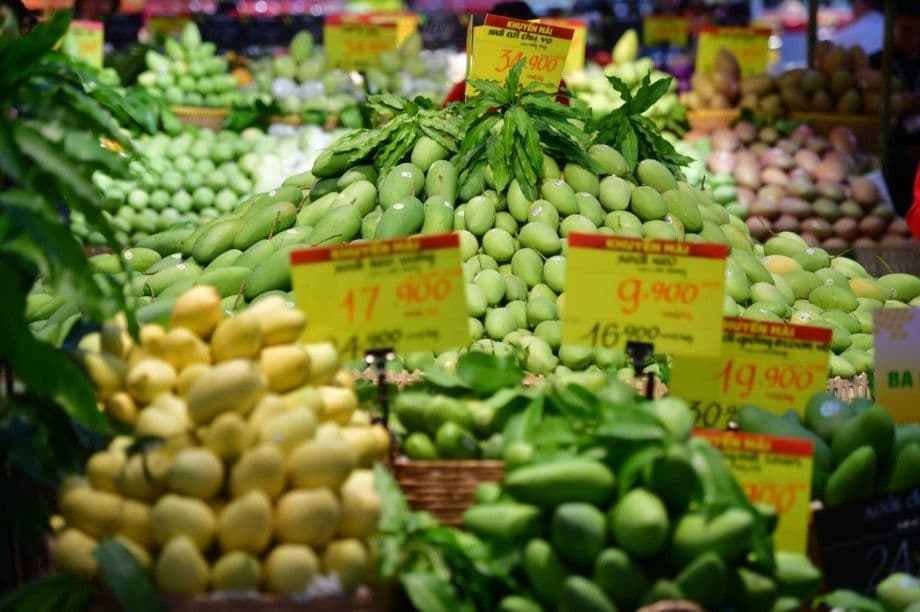
The US spent $358.4 million (nearly VND9 trillion) importing Vietnamese fruits and vegetables last year, up 39% compared to 2023, according to customs data.
According to the Customs Department, the US is the second largest market for Vietnamese fruits and vegetables, after China. Coconuts, dragon fruit, mangoes and almonds are the items with the largest contribution when Vietnamese fruits and vegetables are exported to the world's largest economy.
Of which, coconuts lead the way with nearly 78 million USD, up 54%. Dragon fruit reached 40 million USD, up 32%. Mangoes and almonds followed. In the first month of this year, mangoes, coconuts and dragon fruit continued to grow, while durian and passion fruit decreased.
A director of a fruit export enterprise in Ho Chi Minh City shared that goods exported to the US are good thanks to the large Vietnamese community in major cities. However, geographical distance affects quality and price, making it difficult for exports to reach billions of USD like the Chinese market.
At the same time, the US has strict regulations, requiring businesses to register production facilities and representatives in this country. Every two years, businesses must re-register to be granted a valid business code.
In addition, the growing and processing areas must meet standards such as GlobalGAP, ISO, HACCP, USDA. Agricultural products must not contain pesticide residues, microorganisms, bacteria or mold. The process of harvesting agricultural products must ensure quality to meet import requirements.
In 2024, the export turnover of fruits and vegetables will reach 7.12 billion USD, an increase of 27% compared to 2023. Of which, durian is the main product, accounting for nearly 50% of the total turnover of fruits and vegetables, reaching 3.2 billion USD and mainly exported to China (736,000 tons with a value of 2.94 billion USD). In 2025, Vietnam is expected to harvest about 1.5 million tons of durian, concentrated from April to September.
According to the Vietnam Fruit and Vegetable Association, it is forecasted that in the coming years, the export market will continue to expand with the main regions being China, Korea, ASEAN countries, the US, Canada, and the EU. In addition, there are potential markets such as India, UAE, Australia, and New Zealand. This is a large space for the Vietnamese fruit and vegetable industry to continue to boost exports in the coming years.
To achieve the export target of 10 billion USD by 2030, the fruit and vegetable industry is oriented towards a green economy, emission reduction, circular agriculture, and economical and efficient use of natural resources. Applying high technology, practicing standard processes and regulations in production and processing to create products that meet the requirements of the consumer market.
At the same time, the association focuses on improving the capacity to comply with import market regulations for members and industries. Organizing activities to connect, joint venture, and link production and consumption; building fruit and vegetable supply chains in localities and key fruit and vegetable production areas to create abundant and stable supply sources, contributing to the socio-economic development of localities.
Source: CafeF