EU abandons pesticide cutback plan, but tightens import standards
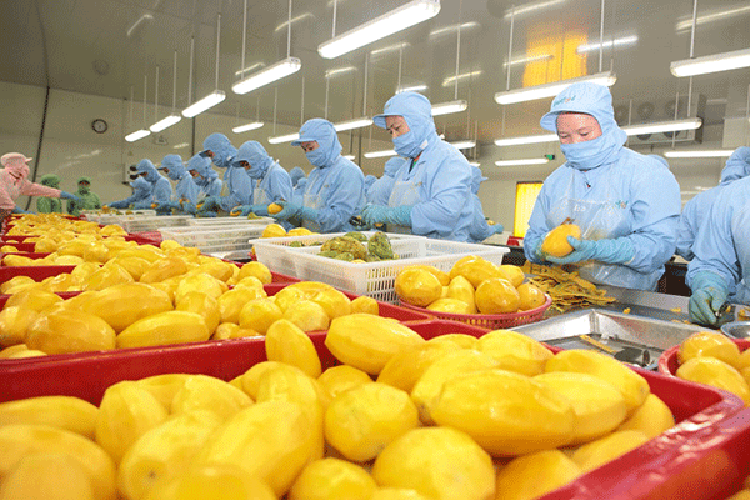
The EU’s abandonment of its pesticide reduction plan could ease the pressure on Vietnamese agricultural exporters to meet strict environmental standards. However, the EU will still tighten import standards...
The Vietnam Trade Office in Sweden reported that the European Union (EU) has officially abandoned its controversial plan to reduce pesticides, as confirmed by EU Agriculture Commissioner Christophe Hansen.
This marks a significant change in the bloc's agricultural strategy, as well as an adjustment in the policy under the European Green Deal.
Previously, the target of reducing pesticide use by 50% by 2030 was the cornerstone of the EU's sustainable agriculture policy. However, this plan was abandoned indefinitely after much controversy and strong opposition from farmers as well as right-wing parties.
According to the Vietnam Trade Office in Sweden, the Sustainable Pesticides Regulation (SUR) plan was proposed in June 2022, setting out strict restrictions, including a complete ban on pesticides in sensitive areas such as urban parks and Natura 2000 reserves. However, the plan was met with fierce opposition from farmers, leading to its withdrawal in 2023.
Mr. Christophe Hansen confirmed that future initiatives will focus on trade and technological innovation, rather than imposing mandatory pesticide reduction targets.
The EU will prioritize raising trade standards and ensuring that imported food complies with the bloc's pesticide regulations. One of the key initiatives is the Biotech Act, which aims to accelerate the development of safer alternatives to traditional pesticides.
The change in strategy reflects the EU's "New Vision for Agriculture and Food" plan, which focuses on attracting young people to the agricultural sector, rather than focusing solely on environmental restrictions.
In response to the EU's policy change, the Vietnam Trade Office in Sweden said that the EU's abandonment of its pesticide reduction plan could help Vietnamese agricultural exporters reduce pressure on meeting strict environmental standards.
However, the EU will still tighten import standards, especially on pesticide residues. Therefore, Vietnamese enterprises need to continue to improve product quality, invest in clean farming technology and ensure compliance with new EU standards to maintain and expand market share in this region.
Previously, on December 18, 2024, the EC issued Regulation No. 2024/3153 on reviewing the application of additional inspection measures and emergency measures to manage the import of agricultural products and food from external markets into the European Union according to Regulation 2019/1793 and made decisions on a number of agricultural products and food originating from Vietnam. Specifically, the EC decided to increase the inspection frequency for durian from 10% to 20%...
The Ministry of Industry and Trade said that the EU's legal system on food safety and animal and plant quarantine is constantly being amended, supplemented and made transparent to protect human, animal, plant and environmental health in Europe.
Regarding general food safety management, the EU has an integrated approach, controlling every link in the production, distribution and export chain.
Agricultural products and food products from third countries, if they want to access the market, the EU will apply different management measures. For example, the EU requires a phytosanitary certificate issued by the competent authority of the exporting country; a phytosanitary certificate and documents to ensure that the shipment meets EU requirements; inspection to ensure that the shipment is free of harmful organisms according to regulations and when physically inspected according to Regulation (EU) 2019/2072...
Therefore, to maintain and expand market share in this market, Vietnamese exporting enterprises need to strengthen product quality control, strictly comply with regulations on food safety and pesticide residues.
Regulatory agencies and domestic industries also need to strengthen coordination, improve supply chain monitoring capacity and increase technical support for businesses, protecting the brand of Vietnamese agricultural products in the international market.
Source: VnEconomy