Seafood exports in the first two months of 2025 and market fluctuations
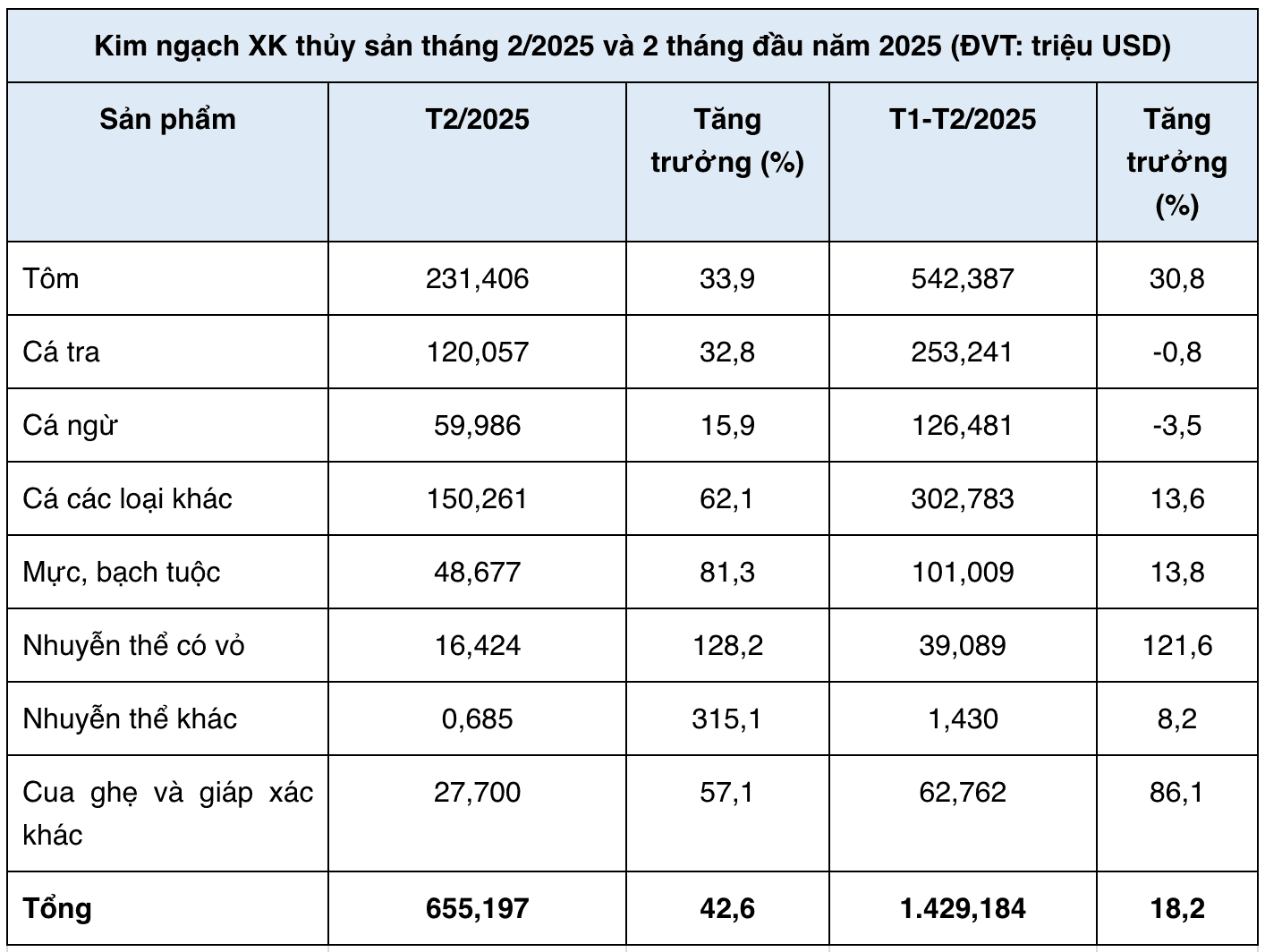
The first two months of 2025 recorded positive signals in Vietnam's seafood export activities, with a total turnover of 1.423 billion USD, an increase of 18.2% over the same period in 2024. Of which, February 2025 reached 655.197 million USD, an impressive growth of 42.6%.
Shrimp: Strong growth driver
Shrimp continued to be the biggest bright spot, contributing USD 542.387 million in the first two months of the year, up 30.8%. In February 2025 alone, shrimp export turnover reached USD 231.406 million, up 33.9%. This recovery shows that the shrimp industry is regaining growth momentum after a period of low prices in 2023-2024. Although imports from China and the US are expected to decline in 2024, other markets such as the EU and some emerging regions have filled the gap, helping global shrimp production to remain stable while prices improve. This is a sign of a healthier balance between supply and demand.
The EU is currently a notable market with imports of fresh, frozen and value-added processed whiteleg shrimp reaching 376,875 tonnes in 2024, up 4% from 2023. The long-term growth trend is clear, with imports in 2024 being 26% higher than in 2019, mainly due to contributions from Ecuador (+78%) and India (+47%). Vietnam has also recorded a partial recovery in supply to the EU, consolidating its position among the top suppliers. However, increasing competition from Ecuador and India requires Vietnam to focus on value-added products and diversify its markets to maintain its advantage.
The outlook for the shrimp industry in 2025 is quite optimistic, provided that uncertainties such as the trade war under the Trump administration do not cause further disruption. Average import prices are expected to increase from October 2024 and remain high throughout 2025 on stable inventories, providing confidence to both exporters and importers.
Pangasius: Price growth but potential risks
Pangasius recorded an export turnover of 253.241 million USD in the first 2 months of the year, but a slight negative growth (-0.8%) compared to the same period. February 2025 reached 120.057 million USD, a strong growth of 32.8%, showing signs of recovery in the short term. The price of commercial pangasius is currently at a 3-year high (VND 32,000-33,000/kg for fish over 1kg/fish), bringing significant profits to farmers (VND 2,000-3,500/kg). This is the result of increased export demand, especially from the end of 2024, when businesses recorded many stable orders until at least June 2025.
However, the pangasius market faces many challenges. Raw material prices are rising due to escalating input costs (feed, labor) and uncertainty from US tariff policy, with an additional 10% tax imposed on processed seafood from China, indirectly affecting global trade flows. Demand in the US remains sluggish, while large inventories may restrain price increases. Pangasius farmers need to be careful not to expand production spontaneously, as current prices may be “virtual” and could easily plummet if supply exceeds demand. Linking with businesses, applying modern farming technology and focusing on value-added products will be the key to maintaining a competitive advantage.
Tuna: Stable amid difficulties and challenges from international regulations
Tuna exports reached 126.481 million USD in the first two months of the year, down slightly by 3.5%, with February 2025 reaching 59.986 million USD, up 15.9%. The Japanese market - one of the main destinations for Vietnamese tuna - showed price stability, albeit at a low level. The price of frozen bigeye tuna at Toyosu Market (Tokyo) remained around 650 yen/kg from the 4th week of 2025, 100 yen/kg lower than the previous year, due to tight supply from the Indian Ocean and the East Pacific. Meanwhile, high-grade bluefin tuna remained scarce, pushing the auction price of high-quality fish at Oma (Aomori) to exceed 10,000 yen/kg on February 20, 2025.
Vietnam's tuna export industry is facing major challenges from major import markets such as the EU and the US. Regulations on combating illegal fishing (IUU) continue to be a major barrier to exploited seafood, including tuna, in which the minimum size of 0.5m for skipjack tuna in Decree 37/2024 is causing fishermen and businesses to not solve the problem of raw materials.
Similarly, the US applies the Marine Mammal Protection Act (MMPA), requiring seafood exporting countries to demonstrate that fishing processes do not harm marine animals and demonstrate management regulations similar to those of the US. The US has just announced that it will not recognize Vietnam as equivalent, and there is a risk of banning the import of many Vietnamese seafood species from January 1, 2026 if Vietnam does not take timely action.
To overcome this, it is necessary to have strong support from competent authorities and industry managers in perfecting the legal framework, improving monitoring capacity and supporting fishermen to comply with international standards.
Other product groups
Product groups such as other fish (USD 302.783 million, up 13.6%), squid and octopus (USD 101.009 million, up 13.8%), shellfish (USD 39.089 million, up 121.6%) and crab (USD 62.762 million, up 86.1%) all show great potential. In particular, shellfish and crab recorded outstanding growth, thanks to strong demand from the Chinese market. However, similar to tuna, exploited products such as squid, octopus and crab are also under pressure from IUU and MMPA regulations. The EU and the US are increasingly tightening control over origin, requiring full and strict traceability. If not met, these items are at risk of being rejected for import, seriously affecting export turnover. Coordination between the Government, businesses and fishermen in building sustainable supply chains is vital to maintaining markets and promoting growth.
Source: VASEP