Sharp decline in exports, how can durian return to the 'throne'?
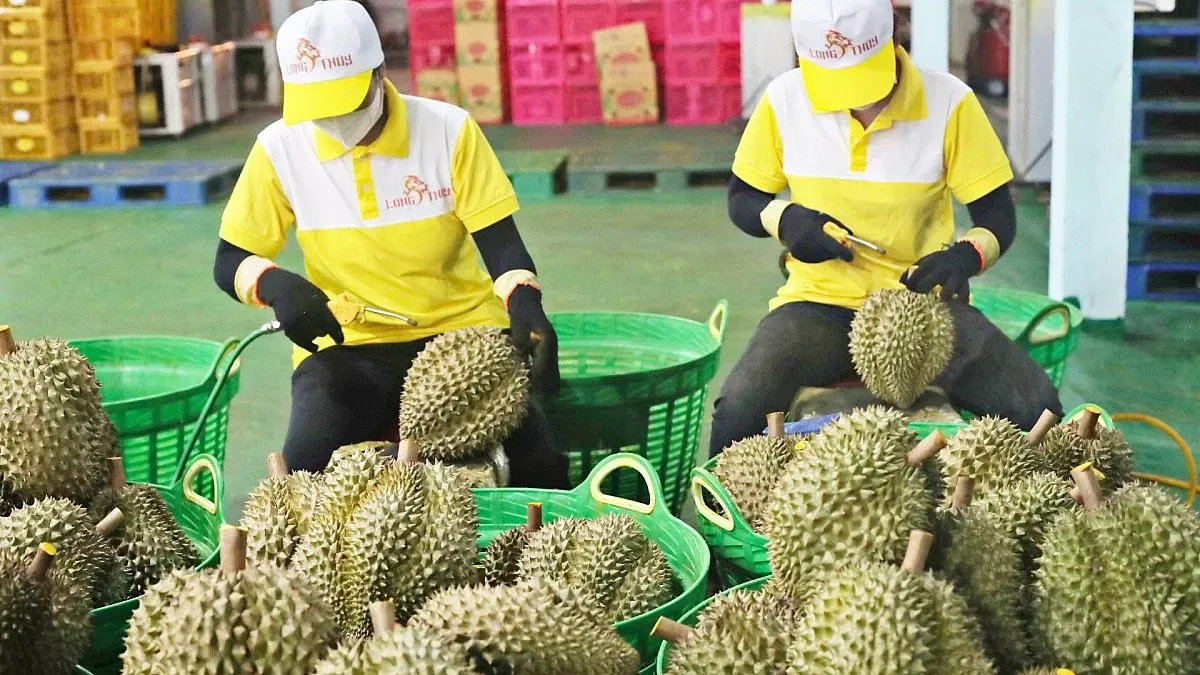
Durian was once considered the king of fruits when its export turnover increased rapidly, accounting for half of fruit and vegetable exports. However, durian exports have now "turned around".
"Shock" for the "king" fruit
According to the Vietnam Fruit and Vegetable Association, the total export value of fruits and vegetables in the first two months of the year is estimated at 677 million USD, down 17% compared to the same period last year. In particular, the export of durian, a key fruit that accounts for nearly half of the industry's total export value, has declined dramatically. By mid-February, durian exports reached only 3,500 tons, down 80% compared to the same period in 2024.
One of the main reasons for this situation is that import markets have tightened quarantine and food safety regulations. China, the largest consumer market, has implemented a policy of inspecting 100% of durian shipments imported from Vietnam. At the same time, from January 10, this country requires shipments to have a certificate of inspection proving that they do not contain yellow O, a compound that can cause cancer. This causes the customs clearance process to be prolonged, increasing the risk of damage to goods, forcing many businesses to return to domestic consumption.
Along with changes from the Chinese market, the EU market has also temporarily increased the frequency of border inspections for durian from 10% to 20%.
The reason for this change is that Vietnamese durian does not comply with regulations on pesticide residue levels. Accordingly, EU authorities have discovered many pesticide active ingredients with high residues on durian such as: Carbendazim, Fipronil, Azoxystrobin, Dimethomorph, Metalaxyl, Lambda-cyhalothrin, Acetamiprid. These active ingredients are regulated by the EU with a maximum residue limit (MRL) of 0.005-0.1 mg/kg depending on the type.
At the border gate areas, according to the Dong Dang - Lang Son Border Gate Management Board, since the beginning of 2025, China has required durian imported from Vietnam to have a certificate of inspection for Cadmium residue and Auramine O (Auramine O). Therefore, since the end of January 2025, fresh durian exported through Lang Son province's border gates has almost stopped because it does not meet the standards.
From the beginning of February 2025 to now, only 25 trucks carrying durian have been exported to China through Lang Son province's border gates, this number is only 5 - 10% compared to the same period in 2024.
Similarly, at Lao Cai border gate, from the beginning of 2025 to now, the number of durian and jackfruit exported through the border gate has decreased sharply compared to previous months and the same period in 2024, because China is conducting strict inspections of these two items.
In particular, durian (a high-value agricultural product for export) has seen a sharp decrease in output, even for many days in the new year 2025, no durian trucks were exported.
Để sầu riêng trở lại “ngôi vua”
This is not the first time durian exports have encountered difficulties. Throughout 2024, authorities have repeatedly warned about durian being fraudulently assigned growing area codes. The reason is that the rapid growth of durian exports has caused some businesses to cheat on growing area codes, taking durian from areas that are not granted growing area codes and pasting codes in licensed areas. This situation has caused the other side to warn many times that if it is not resolved, durian exports will be tightened.
Also due to the rapid growth, many exported durian batches have not met the standards of the import market. This is the reason why durian exports have been warned by many markets, affecting export turnover.
In an interview with a reporter from the Industry and Trade Newspaper, expert Vu Vinh Phu pointed out that in the first two months of the year, durian exports declined sharply due to the fact that markets, especially China - the largest market for Vietnamese durian, reduced imports. Accordingly, this market has tightened management and proposed many new regulations for imported goods, including durian. Strengthening regulations on imported goods not only causes export turnover to decline but also causes businesses to increase storage and transportation costs.
“Businesses must determine that not only China but also many other import markets will increase barriers to control imported goods. Therefore, they must constantly update new information from the market. At the same time, they must maintain quality and ensure standards to maintain export turnover,” said expert Vu Vinh Phu.
In the context of current difficulties in durian exports, expert Vu Vinh Phu said that the immediate solution is for ministries, sectors and localities to increase licensing for testing centers so that businesses can have more testing facilities, solving difficulties in the current period.
In the long term, ministries and sectors need to make efforts to support businesses in diversifying export markets and finding more opportunities for durian products.
“In particular, units and localities must also make efforts to “shock” the production process to ensure that durian is not caught up in unnecessary barriers when exporting. It must be understood that regulations and standards must be overcome because only by overcoming them can the market be maintained,” emphasized expert Vu Vinh Phu.
In 2024, durian exports will reach 3.4 billion USD, breaking the record set in 2023 and contributing nearly half of the export turnover (more than 7.2 billion USD) of the entire fruit and vegetable industry.
Source: Cong Thuong Newspaper