Resolution No. 57: New vitality for the agricultural sector
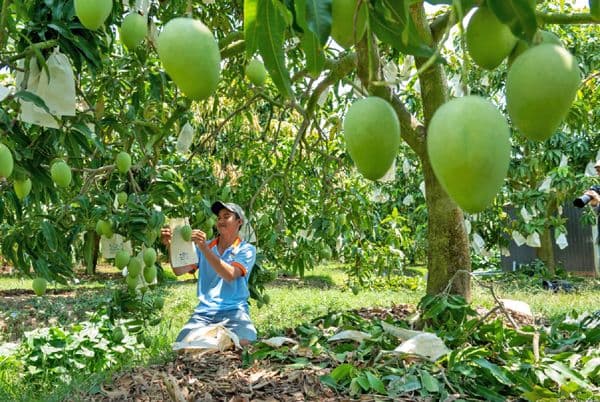
At the Seminar on the implementation of Resolution No. 57-NQ/TW on breakthroughs in science and technology development, innovation and national digital transformation, many scientists affirmed that Resolution No. 57 brings new vitality to the agricultural sector.
From “Contract 10” of Vinh Phuc Provincial Party Secretary Kim Ngoc
The late Secretary of Vinh Phuc Provincial Party Committee - Mr. Kim Ngoc, who is considered the father of the 10-contract policy. In the years 1966-1967, when the Northern countryside all applied the cooperative business model, Vinh Phuc Provincial Party Committee Secretary Kim Ngoc made a bold decision, one could say reckless, when allocating land to each farmer household. This went beyond the scope, framework of thinking, viewpoints, and policies at that time.
To have this breakthrough thinking, many scholars have analyzed that Secretary Kim Ngoc was a very dynamic and creative leader, not bound by existing formulas. He always thought and wondered how to develop production truly and effectively. Taking economic efficiency as a measure of the correctness of policies and guidelines, not the model, viewpoint of collectivization and cooperation. Along with that, the decision to contract came from the viewpoint of serving the people, how to bring a good life to the people; how to ease the suffering of farmers, how to promote production development, to make greater contributions to the country. And in fact, then, in 1988, the Politburo issued Resolution 10 on innovation in agricultural management - the starting point of Doi Moi. After only one year of implementation, in 1989, from a food importing country, we exported 1 million tons of rice.
After nearly 40 years of development, the phrase "contract 10" was once again mentioned in the context of our country entering the era of national development, the first time being the 14th National Congress of the Party, marking 40 years of Doi Moi (1986-2026).
Resolution No. 57-NQ/TW of the Politburo on breakthroughs in science, technology, innovation and national digital transformation is considered by scientists and intellectuals as a call and command for all intellectuals and scientists in the country and overseas Vietnamese, as well as all classes of people to participate in scientific research, application of new technologies and digital transformation to develop productive forces, improve production relations, improve labor productivity, national competitiveness, and serve the country's socio-economic development. For intellectuals and scientists, Resolution 57 is like "contract 10" in the new context, bringing a breath of life to socio-economic development in the new era.
To practical benefits
For old farmer Dang Van Nhung, Chairman of Tam Que Hoi Quan, Tan Thuan Tay Commune (Cao Lanh City - Dong Thap), the application of technology and digital transformation for farmers like him starts with taking care of the mango garden. There is no need to go to the garden, just with a smartphone installed with some applications, parameters related to the soil, water, and temperature environment in the garden are recorded from the monitoring station updated in real time, helping him to promptly take measures to take care of the trees.
In addition, each mango tree in the specialized area of about 500 hectares of Tan Thuan Tay Commune is also attached with a QR code, which is very convenient for tracing the origin, transparency of product quality, meeting the requirements of many "difficult" markets.
Dong Thap Provincial People's Committee is implementing comprehensive digital transformation in terms of digital government, digital economy and digital society. Over 58% of small and medium-sized enterprises conduct business activities on e-commerce trading floors, nearly 61% of the population participates in online shopping. According to Dong Thap Provincial Party Secretary Le Quoc Phong, for digital economic development, Dong Thap has promoted support for small and medium-sized enterprises to transform digitally; supported enterprises, cooperatives, and households to convert traditional production methods to production using digital technology; increased buying and selling activities through e-commerce trading floors; promoted cashless payments, etc.
Currently, there are over 430 products of enterprises, production facilities, and cooperatives in the province maintaining business on e-commerce floors. Some enterprises in Dong Thap have gradually applied smart systems in production activities such as centralized integrated production management systems; smart warehouse processing systems, enterprise resource planning; production planning and management systems.
In Luc Nam district (Bac Giang), gardeners all know the creative and scientific method of Mr. Vu The Cuong (born in 1974) when grafting Canh orange trees onto Dien grapefruit trees.
Through books and newspapers, he saw that grafting Canh orange trees onto grapefruit trees would make the trees stronger and less susceptible to pests and diseases, so he studied and learned this technique.
He chose orange trees with large, strong branches that were not cut by pests and diseases, and grafted them onto 1,500 Dien grapefruit trees. When he first built the model, he encountered many difficulties due to lack of experience, so his family's orange and grapefruit gardens did not yield high economic efficiency. Not discouraged by the difficulties, he researched and learned from predecessors and through agricultural extension programs on television, books, newspapers, and the internet. After two years of planting, his family's orange and grapefruit gardens began to generate profits.
According to Mr. Cuong, Canh orange trees are difficult to grow, and if not properly cared for, it will affect productivity and quality. Therefore, when the tree is about to bear fruit, he rings the base, sprays flower bud protection chemicals, then uses the technique of tightening the water and providing nutrients to the tree through the leaves. To make the fruit juicy and sweet, during the care process, he rarely uses inorganic fertilizers but mainly fertilizes with organic fertilizers and increases the amount of potassium for the tree.
Mr. Cuong's farm has about 6,500 orange trees and 6,000 green-skinned grapefruit trees, yielding 20 tons of fruit per crop; earning about 1.5 billion VND in profit each year.
Science must enter life
At the Seminar on the implementation of Resolution No. 57-NQ/TW on breakthroughs in science and technology development, innovation and national digital transformation, Minister of Agriculture and Rural Development (currently Vice Chairman of the National Assembly) Le Minh Hoan affirmed that in recent times, the team of scientists has produced products that meet urgent demands from practical life.
For example, in the field of plant varieties, scientists have created new varieties that not only have high yields, but are also resistant to climate change and diseases; in aquaculture, modern farming technology helps minimize environmental impacts, while ensuring products meet international standards and expanding export markets.
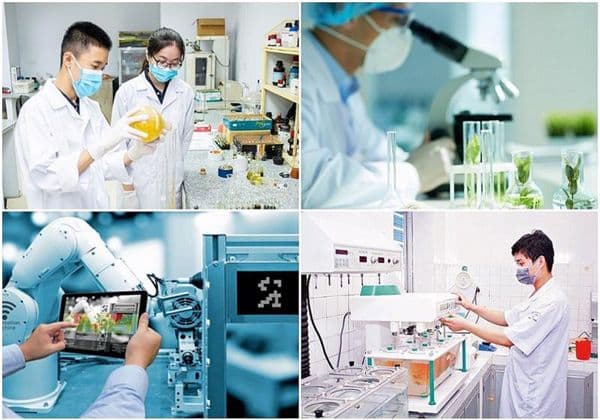
Science and technology will enhance Vietnamese agricultural products.
Regarding livestock and veterinary medicine, research institutes have developed many biotechnologies in improving livestock breeds, controlling diseases and improving the nutritional quality of livestock products, better meeting the increasing demands of consumers. Regarding forestry, scientists have researched and successfully implemented sustainable forest cultivation methods, not only contributing to environmental protection but also creating livelihoods for people...
However, in the current context, Mr. Le Minh Hoan raised the question: How can agricultural science continue to create breakthroughs? How to turn Vietnam from a raw material exporting country into a center for high-value and sustainable agricultural production?
Therefore, Mr. Le Minh Hoan emphasized that training institutions and leaders of research institutes need to innovate their thinking, create creative spaces to form a synchronous innovation ecosystem.
Mr. Le Minh Hoan believes that science and technology need to touch people's lives, when doing research, we need to think about what farmers and businesses need to orient our research. In the context of limited facilities and resources, training institutions and institutes need to cooperate and share with each other for mutual development.
He also shared the message "Science meets life". Scientific research does not stop at theory but must be transformed into specific solutions and useful products to serve farmers, fishermen and the community.
"No matter how complex a technology is, it is only valuable when it is applied in practice, when it helps people grow plants, raise children and improve their lives", Mr. Le Minh Hoan affirmed.
Therefore, we need a newer, more open approach to resources participating in research, scientific and technological development, innovation and digital transformation in the agricultural sector.
Vice Chairman of the National Assembly, former Minister of Agriculture and Rural Development Le Minh Hoan emphasized that the era of national development is also the time when the world is living in the era of artificial intelligence.Applying science and technology, innovation and digital transformation in the agricultural sector is a responsibility to contribute to the overall development of the country. Therefore, it is necessary to have practical, long-term thinking, not only theory but also practical solutions. Innovation cannot bring results overnight, science and technology will have a certain delay, so we must be persistent, tenacious, and have a long-term vision. Scientific research will have risks, so it is necessary to review and draw practical experiences to achieve success.
Source: Kinh Te Nong Nghiep Newspaper