Seafood businesses worry about losses of thousands of billions of dong
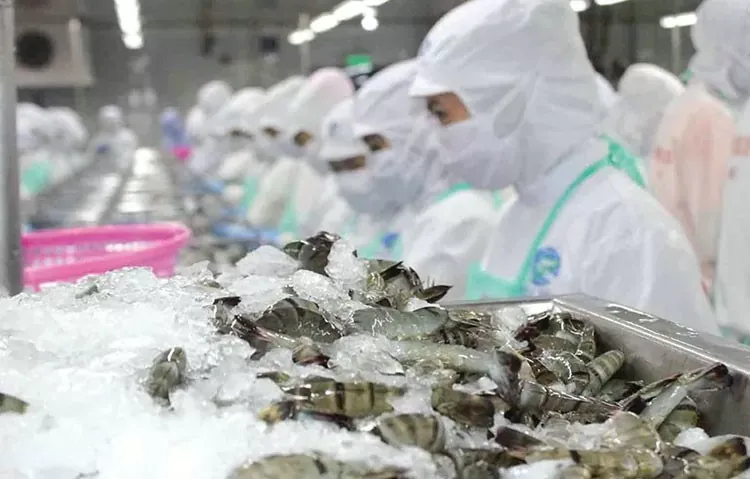
Some provisions in the Draft Decree amending and supplementing a number of articles of Decree 15/2018/ND-CP on food safety are inappropriate, causing difficulties for businesses.
Concerns about creating new bottlenecks for businesses
The Vietnam Association of Seafood Exporters and Producers (VASEP) has just sent a document to Deputy Prime Minister Le Thanh Long; the Ministries of Health, Justice, Agriculture and Environment, and Industry and Trade, providing comments on the draft Decree amending and supplementing a number of articles of Decree 15/2018/ND-CP detailing the implementation of a number of articles of the Law on Food Safety.
The document clearly states that in the past 7 years since its promulgation, Decree 15/2018/ND-CP (hereinafter referred to as Decree 15) has been assessed by the Government and the business community as an effective reform model in food safety management, integrating according to the risk management principles that advanced countries in the world are applying, thereby helping businesses save millions of working days and thousands of billions of VND/year.
Practices in the years of implementing Decree No. 15 show that the food industry has had high growth even during the pandemic, contributing about 15% to GDP; 0.38 percentage points to GDP growth in 2021; 1 percentage point to GDP growth in 2022 (Report on the assessment of the impact of Decree 15/2018/ND-CP on the production and business activities of food enterprises, CIEM 2023).
However, the Draft Decree amending and supplementing a number of articles of Decree 15 is creating new requirements and new bottlenecks, causing difficulties for the production and business activities of enterprises while not providing more effective solutions than Decree 15 to ensure food safety for people.
Accordingly, the draft Decree supplements and increases many requirements and administrative procedures - most of which are not related to food safety, causing difficulties for businesses.
Specifically, the draft is adding many requirements and regulations to all 3 groups of administrative procedures on self-declaration; registration of declaration; re-registration of declaration. Among them, there are many unreasonable regulations, inconsistent with international practices, and the risk of creating many new bottlenecks for production and business, making it difficult or impossible for many food products, especially seafood, to meet. Meanwhile, many additional requirements in these procedures of the draft have nothing to do with food safety.
According to estimates, with the self-declaration procedure, the increased dossier components and time will cause business delays of at least 3 months and losses of thousands of billions of VND/year. With the declaration registration procedure, the increased dossier components can cost hundreds of billions of VND/year, and the number of additional working days cannot be determined.
“The seafood business community is particularly concerned about the addition of the above requirements and contents to the above self-declaration procedures/forms. It is also completely unclear what the purpose of adding the above information requirements (some of which are not related to food safety, such as drug and pharmaceutical management) is to resolve the arising situation that causes food insecurity. We recommend keeping the information requirements related to the self-declaration procedures as they were designed effectively and appropriately in Decree 15/2018,” informed Mr. Nguyen Hoai Nam - General Secretary of VASEP.
Another issue mentioned by VASEP is that the subject of management is not appropriate. Specifically, the draft is only focusing on strict administrative management of pre-packaged processed foods, while not providing appropriate solutions to prevent food poisoning related to street food, fresh food, collective kitchens, etc., which have been identified in the past as products with high potential risks of causing food safety problems and are the main causes of food poisoning. Therefore, VASEP recommends that the Drafting Committee review and adjust and supplement the management objects to be consistent with the principles of risk management.
Many solutions for amendment and supplementation are not suitable.
According to VASEP, many of the measures proposed in the draft are not based on international food safety management principles. In particular, the draft clearly shows that it is not consistent with the Solutions for developing food safety laws stated in the Summary Report on 5 years of implementing Decree 15 No. 1895/BC-BYT dated December 31, 2024, Section II, Point 1 of the Ministry of Health.
Specifically, there are no regulations to complete the system of standards and technical regulations on food safety; additional requirements have not thoroughly applied the principles of risk management and shifted from pre-inspection to post-inspection; there are no solutions to assess risks along the chain and there is no thorough decentralization and delegation of authority; there are no specific regulations on thoroughly applying procedures (registration, declaration, etc.) in the electronic environment and building a database in unified food safety management from the central to local levels.
Some existing and arising issues in the regulations on food safety management that Decree 15 has not mentioned have not been included in this Draft. Specifically, the regulation on the time allowed for establishments that have not yet achieved the required improvement to be granted a Certificate of eligibility to ensure food safety is not fair among the subjects.
There are no regulations on the MRPL threshold (minimum analytical performance limit), RPA (reference threshold for activities) for prohibited substances, substances not on the list of permitted substances, leading to the fact that some products cannot be brought into retail channels in the domestic market while being eligible for export to demanding markets such as the EU and the United States due to the presence of residues of some antibiotics and chemicals banned from use, although the residue levels of these active ingredients in the product are very low, meeting the EU.
There are no regulations on documents replacing the Business Registration Certificate in the application for a Food Safety Eligibility Certificate for entities that do not have a Business Registration Certificate because they are not a business model. There are no regulations on changing the purpose of use for imported products for export processing, export processing, internal use/production but in excess.
3 recommendations from VASEP
Given the above shortcomings, VASEP recommends that Deputy Prime Minister Le Thanh Long consider directing the Ministry of Health and the Drafting Committee to study the comments, remove unreasonable draft regulations, and supplement appropriate management measures to ensure that the Decree is developed in accordance with the instructions of the General Secretary and the Government, as well as the solutions in Report No. 1895/BC-BYT to avoid creating bottlenecks for production and business and to ensure food safety for the people as well as improve management efficiency.
At the same time, it is recommended that the Government chair a dialogue meeting between the Drafting Committee and relevant food industry associations to review the final draft before submitting it to the Government.
Currently, the Government is also amending the Food Safety Law, scheduled to be issued in October 2025, after which there will be a Decree guiding its implementation. To avoid overlap between legal documents and ensure effectiveness in institutional reform, it is recommended that the Government consider amending the Food Safety Law first, then amending the Decree guiding the implementation of the Law.
According to statistics from the General Department of Customs, in January 2025, Vietnam's seafood exports reached 773.95 million USD, an increase of 3.5% compared to January 2024.Seafood export markets achieved growth such as China, Australia, Thailand, Germany, etc. Of which, seafood exports to the Chinese market increased the most, up to 80.8% compared to the same period in 2024. In contrast, seafood exports to Japan, the United States, and South Korea decreased by 7.6%; 3.5%; 9.5% compared to the same period in 2024.It is forecasted that the global seafood market in 2025 will have many fluctuations, with factors such as changes in consumer habits, tariff policies and fluctuations in supply and demand affecting Vietnam's seafood exports... Therefore, Vietnam's seafood needs to increase value, improve product quality and expand new export markets...
Source: Cong Thuong Newspaper