EU Code Certification – The missing link in Vietnam’s seafood export chain to Europe
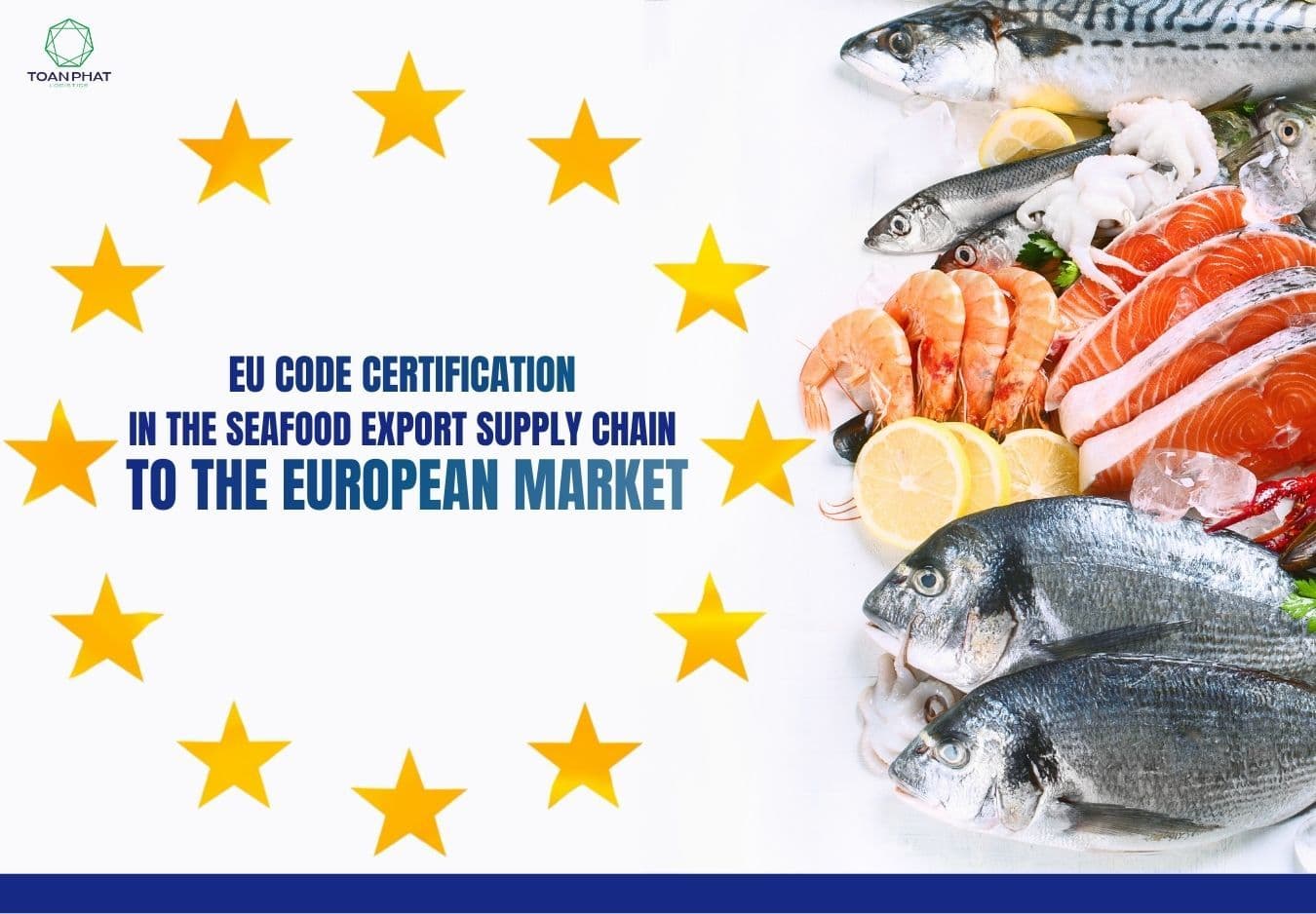
More than a legal requirement, the EU Code has become a decisive competitive condition, serving as a guarantee of food safety and operational capability for enterprises participating in Vietnam’s seafood export supply chain to the European market.
Controlling the supply chain, not just the product
In recent years, food safety management in stringent markets—particularly the European Union (EU)—has gradually shifted from inspecting finished products to controlling the entire supply chain. This shift is especially evident in the seafood sector, a category considered high-risk in terms of food safety and storage quality.
Under this approach, a frozen seafood product seeking access to premium markets must not only meet standards at the processing plant, but all stages related to storage and handling throughout the logistics chain must comply with equivalent requirements. Cold storage facilities therefore become a mandatory link, directly responsible for maintaining food safety conditions throughout the storage period.
A dedicated standard for cold storage serving seafood exports
EU Code is an identification number granted by the EU’s competent authorities to facilities authorized to participate in the seafood export supply chain to Europe. For cold storage facilities, the EU Code is not a symbolic certification; it focuses on assessing actual operational capacity, including:
- Hygiene and food safety conditions of the warehouse
- Temperature monitoring and recording systems
- Inbound, outbound, and storage procedures
- Batch-level traceability capabilities
- Consistency and transparency of operational records
The core principle of the EU Code lies in recognizing only those cold storage facilities capable of maintaining standards consistently in daily operations, rather than merely achieving compliance at a single point in time.
A critical intersection in the seafood export chain
In the frozen seafood export journey, cold storage acts as the intersection of multiple links—from production and processing to storage and export preparation. Any deviation at the cold storage stage can disrupt the continuity of the cold chain, even if all preceding stages have been properly controlled.
A cold storage facility certified with EU Code helps ensure that:
- Product quality remains stable throughout storage
- Risks of cross-contamination or temperature deviation are strictly controlled
- Cold-chain documentation is fully recorded and traceable when required
This is why an EU Code–certified cold storage facility is regarded as a safeguard of supply chain integrity, rather than merely a logistics service provider.
How EU Code differs from other cold storage certifications
A common misconception is that ISO 22000 or HACCP alone is sufficient to demonstrate a cold storage facility’s safety and quality. In practice, these certifications and the EU Code serve different roles and do not replace one another:
- ISO / HACCP: Assess food safety management systems
- EU Code: Represents official approval by the EU, allowing the facility to directly participate in exports to Europe
In other words, ISO and HACCP form the management foundation, while the EU Code is a mandatory legal and technical condition for cold storage facilities handling frozen seafood destined for the EU.
EU Code - Certified cold storage as a competitive advantage
When cold storage facilities within the supply chain hold EU Code certification, seafood exporters are better positioned to meet increasingly stringent requirements from demanding markets, especially the EU. Standardization at the storage stage helps enterprises:
- Reduce pressure in export documentation and compliance
- Minimize additional costs arising from technical warnings
- Enhance credibility with import partners
- Establish a foundation for long-term trade relationships
As a result, the EU Code is no longer an added bonus but has become a key criterion for selecting cold storage partners in the seafood export chain to Europe.
TOAN PHAT LOGISTICS Completes the EU Code link in the logistics chain
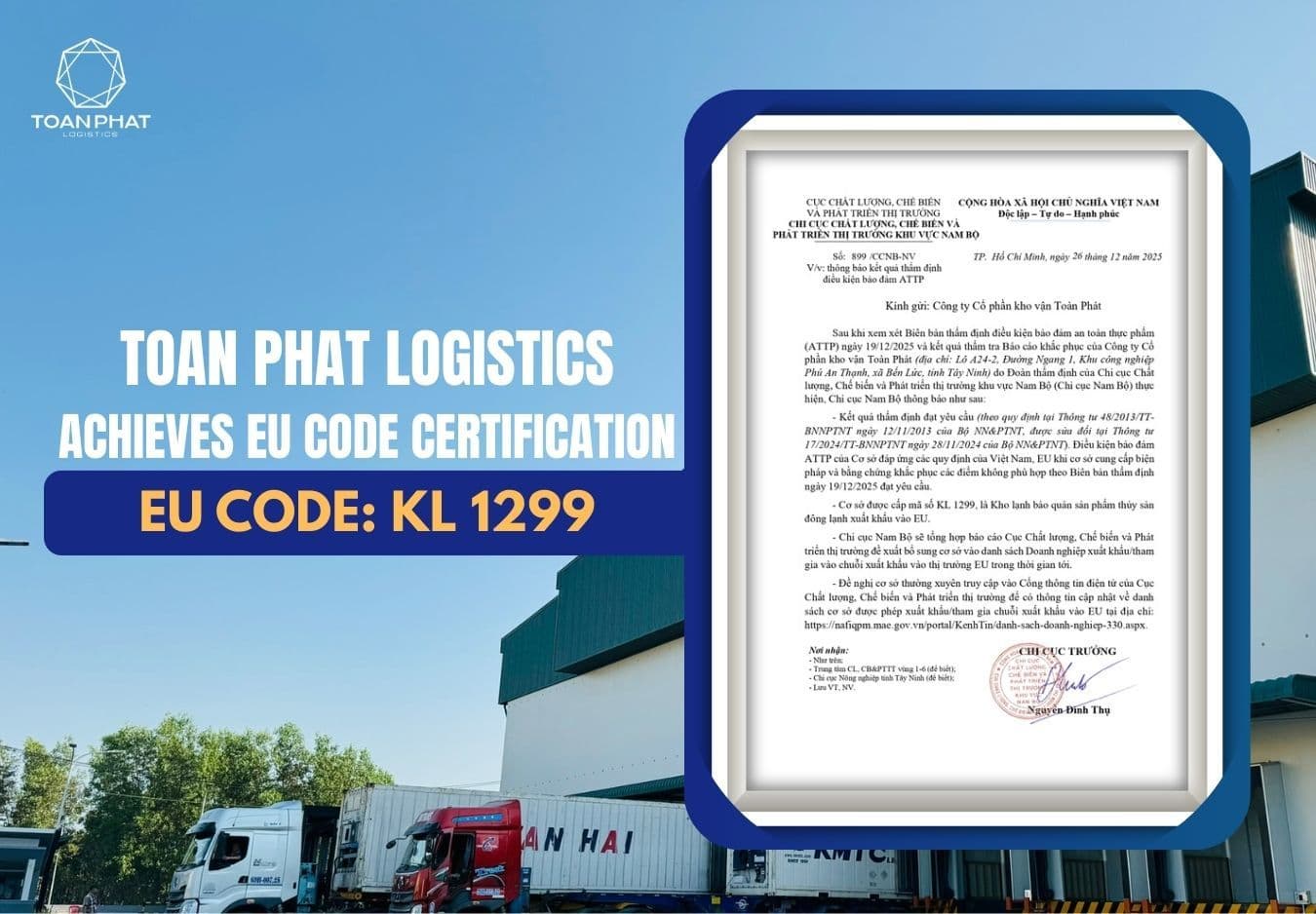
The certification of TOAN PHAT LOGISTICS with EU Code for frozen seafood storage exports to the EU is the outcome of a rigorous assessment of infrastructure and operational capacity.
This certification confirms that TOANPHAT’s cold storage system:
- Fully complies with EU requirements on food safety and traceability
- Operates under a unified and standardized management framework
- Is ready to participate in seafood export supply chains serving high-standard markets
Accordingly, TOAN PHAT LOGISTICS has become a reliable link in the post-harvest logistics chain for seafood exporters.
EU Code – Completing the seafood export chain
As importing markets continue to tighten supply chain controls, the EU Code has become a mandatory condition for cold storage facilities handling frozen seafood. Beyond compliance, it serves as a foundation for risk mitigation, quality assurance, and sustainable development in the European market.
A sustainable export chain can only exist when there are no weak links and EU Code certified cold storage is precisely the component that ensures continuity and resilience across the seafood supply chain.
Contact us:
- Hotline/Zalo (24/7): 093 100 0001
- Fanpage: facebook.com/kholanhtoanphat
- Website: www.kholanhtoanphat.vn
- Address: Block A24-2, Ngang 1 Street, Phu An Thanh Industrial Park, An Thanh, Ben Luc, Tay Ninh, Vietnam