Competition Intensifies in the Canadian Tuna Market

Canada is currently one of the five main tuna import markets of Vietnam. In the past two years, under the impact of economic recession and increased competition, Vietnam's tuna exports to this market have shown a slowing growth trend.
Processed and canned tuna exports have decreased sharply
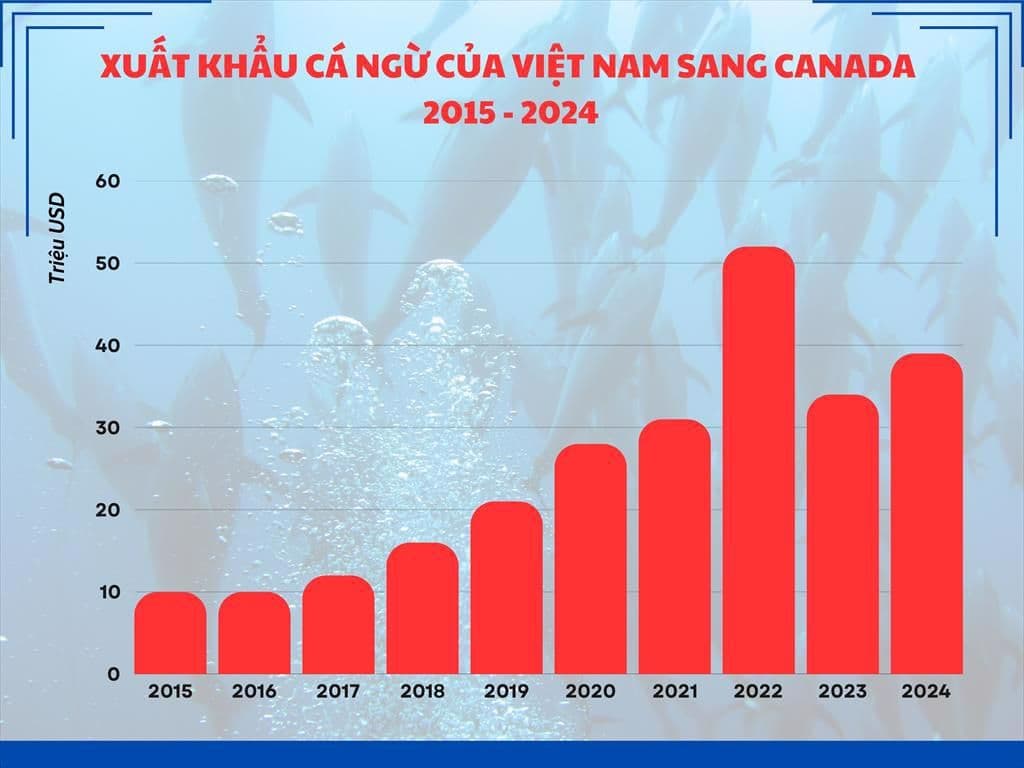
According to statistics from Vietnam Customs, Vietnam's tuna exports to Canada, after reaching a peak in 2022, reaching nearly 52 million USD, decreased to 39 million USD in 2024, down 25%. Although the export turnover in 2024 increased compared to 2023, the growth rate to this market in the past year was unstable, and tended to slow down at the end of the year.
Frozen tuna meat/loin code HS0304 and canned tuna code HS16 are the two main export product groups to this market. In 2024, while frozen tuna meat/loin exports increased sharply by 42%, canned tuna exports decreased by 16% compared to the previous year.
Since the CPTPP Agreement took effect, Vietnam's exports of canned tuna products code HS16 to Canada have increased significantly. However, the shortage of skipjack tuna raw material supply from domestic fleets is holding back export orders not only to the EU market but also to markets with trade agreements with Vietnam such as Canada in the past year.
Tariff incentives are no longer a unique advantage
Currently, Vietnam is the third largest tuna supplier to the Canadian market. According to the agreement in the Comprehensive and Progressive Agreement for Trans-Pacific Partnership (CPTPP), Vietnamese tuna products exported to this market will have their tax reduced to 0% from the beginning of 2019. Particularly for canned tuna products, Vietnamese products will have their tax reduced from 5.75% to 0%. This tax rate has created a driving force to promote Vietnamese tuna exports to Canada over the past 6 years.
However, along with the trend of globalization and integration, free trade agreements (FTAs) are also increasing rapidly. In addition to Vietnam, Canada is also expanding the signing of FTAs with countries, including countries that are competitors of the Vietnamese tuna industry such as Ecuador.
After months of negotiations, the two governments have reached a comprehensive trade agreement addressing market access for goods, services and investment, which is set to be signed in the near future. The agreement includes tax reductions for more than 2,000 Ecuadorian products exported to Canada, including tuna. Thus, with a strong domestic fishing fleet, favorable geographical conditions and tariff incentives when the FTA is signed, Ecuador is considered a strong competitor in the Canadian tuna market.
Not only Ecuador, according to information from the Indonesian Ministry of Fisheries, this country is also boosting exports to this market, especially canned tuna.
All of this is increasing competition in the Canadian tuna market. The tax benefits from tariff incentives will no longer be exclusive to Vietnam. Therefore, increasing raw material sources from domestic fleets will be an advantage for countries that have FTAs with Canada.
Source: VASEP